AI
ADDED VALUE
STRATEGY
Palantir: revenue up 85%, a quarter of its market value lost, and an intelligence that is not its own
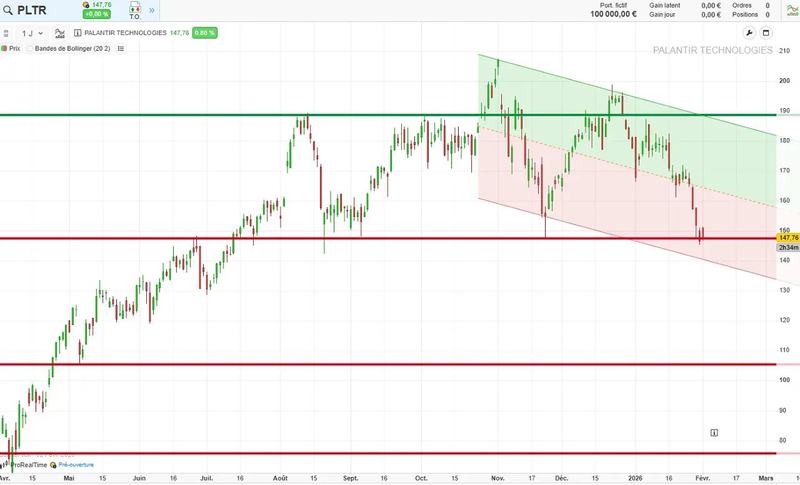

The core of Palantir’s business: structuring data at scale and plugging it into OpenAI or Anthropic. But there is a catch, because the intelligence is not theirs. And now, everyone can do the same.
Palantir is much talked about: contract renewals with the DGSI (France’s domestic intelligence agency), revenue that has almost doubled (+85% over a rolling year)…
Yet it has lost a quarter of its market value since its peak valuation last November.
This paradox (doubling revenue while losing a quarter of its market value) points to a problem that is still invisible.
In practice, Palantir is a kind of refinery that collects raw, scattered, poorly structured data and turns it into something usable. Particularly relevant for organisations handling large volumes of poorly structured data.
And that is where intelligence is needed, and that intelligence Palantir buys from OpenAI or Anthropic.
As long as nobody else knew how to build this operational layer, all was well. But today, that is no longer the case.
Anthropic, OpenAI and other players are building it: platforms able to structure data so it can be used with their own models.
Palantir is no longer the only supplier.
And when the intelligence is not yours and structuring data is no longer your monopoly, what is left?
Although it is not the only cause, this is partly what the market is pricing in.
Beyond the questions this raises, it is a dynamic every company should watch closely.
The added value of an offer is never secured for good. It shrinks as soon as someone else can do the same thing. And in today’s technology ecosystem, that “someone else” may be your own supplier.
A company must always be distinctive enough to remain irreplaceable.
Not in the marketing sense, but in the operational sense: can someone build exactly what you do, without you? If the answer is yes, the question of added value arises.
At France-IX, added value is anchored in something hard to reproduce, a unique combination: a neutral infrastructure, a community of more than 600 interconnected networks, unrivalled availability, two peering platforms sealed off from each other, and a central position in the French Internet ecosystem.
If there is one thing to remember, it is that Palantir did not execute badly, they simply built on a foundation that others could reproduce.
Incidentally, Anthropic filed for its IPO a few days ago at more than 2.5 times Palantir’s market capitalisation. Food for thought!
This news was first published on LinkedIn. To comment or share it, head to the original post. → See the post