BIG TECH
SOVEREIGNTY
SUBMARINE CABLES
Submarine cables: the newest ones belong to Big Tech
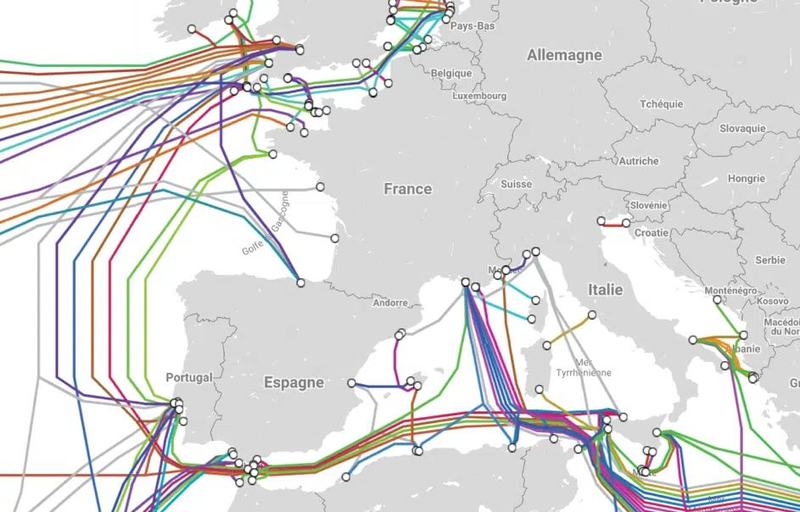

A few weeks ago, I wrote that 70% of submarine cables were owned by Big Tech. We are talking here about “recent” cables and the usable capacity associated with them.
A submarine cable has a technical lifespan of 25 to 30 years. After that, it stays at the bottom of the ocean (at least the sections lying in international waters, since sections in national waters can be decommissioned).
A cable’s usefulness depends in particular on the technology used and its capacity, and therefore on its relevance for continuing to carry traffic.
Take two examples: the TAT-14 cable, commissioned in 2001 and partly dismantled at the end of 2021 for its French section, had a transport capacity of 9 terabits, whereas Google’s Dunant cable, which took over from TAT-14, was commissioned in 2020 with a transport capacity of 250 terabits. Meta’s Amitié cable, even more recent, reaches 400 terabits.
That is a ratio of 1 to 44.
An old operational cable therefore offers only 2% of what a recent cable can carry. On paper, the two cables can coexist. Yet they are far from contributing equally to the Internet we use.
Today, the dozens of cables owned by Alphabet, Meta, Microsoft and Amazon are among the most powerful in the world and account for the overwhelming majority of global internet traffic carried.
For decades, submarine cables were built and owned by large consortia of international operators. The tech giants were merely customers renting bandwidth.
Over the last ten years or so, they have become the owners and the operators, and the operators their customers. And this shift raises questions of sovereignty.
Controlling the active cables potentially means controlling data flows, deciding which routes information takes, but also wielding influence over the states, businesses and citizens who depend on these infrastructures to function.
As a reminder, in France, the two most recent cables landing in the Bay of Biscay (Dunant and Amitié) belong to Google and Meta respectively.
So we cannot change who owns the cables at the bottom of the oceans, but we can act on what we control: how traffic is handled once it reaches our territory.
Keeping data in France, reducing dependence on foreign nodes, interconnecting local players directly: these have been France-IX’s missions for 15 years.
This news was first published on LinkedIn. To comment or share it, head to the original post. → See the post