AI
MESSAGING
SOVEREIGNTY
Slack, AI and our conversations: sovereignty also depends on the messaging we use
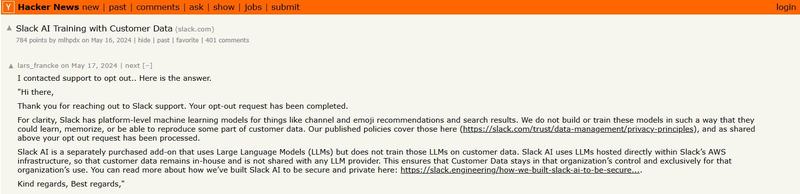

In May 2024, Slack was using the business conversations of millions of users to train its AI models. Here is why sovereignty also depends on the messaging tool we use.
Exactly two years ago, a user posted a link to Slack’s privacy policy on Hacker News. The post went viral within hours.
What users discovered: since September 2023, Slack had been using messages, files and content from business workspaces to train its AI models. All users were included by default.
To opt out: send an email manually to a specific address, a step only the workspace administrator could take, not individual users.
When we talk about digital sovereignty, we rarely think of messaging tools. Yet that is where some of the most sensitive information circulates.
And the issue is not only AI training; it raises a whole set of questions: which law applies to the data passing through your messaging? Where is it hosted? Who can access it, and under what legal conditions?
A US messaging service, even with strong technical safeguards, remains subject to US law and therefore potentially to the Cloud Act.
So using Slack and Gmail means entrusting most of your business communications to two US players, subject to the same jurisdiction and exposed to the same risks. The question of risk concentration cannot be ignored.
Diversifying tools is good resilience practice AND a concrete answer to a structural risk.
Sovereign alternatives exist, such as Mattermost, if operated in Europe.
But migrating an entire organisation to new tools is a project that requires preparation: power users need advanced features and smooth synchronisation, while occasional users need a familiar interface so they don’t drop out along the way.
Among the questions raised by a change of tools, how to make it without losing the teams must be addressed.
Digital sovereignty is not built in a day, and sometimes it starts with asking: do I really know what happens to the data that passes through my messaging?
This news was first published on LinkedIn. To comment or share it, head to the original post. → See the post