CLOUD
DIGITAL SOVEREIGNTY
ENERGY
After Russian gas, Europe is repeating the same mistake with the American cloud
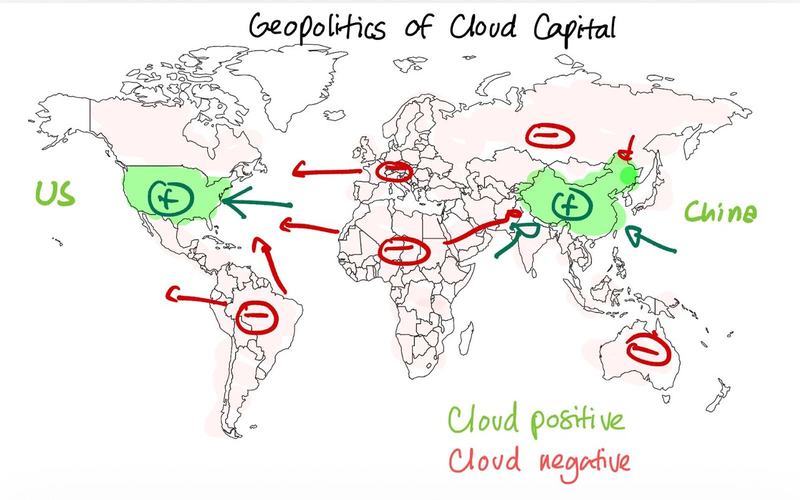

It took Europe 50 years to understand its dependence on Russian gas. It is now repeating the same mistake with the American cloud.
On the one hand, the 2023 IFPEN map leaves no room for doubt: Europe is a massive importer of energy.
Oil flows converge on it from the Middle East (1,414 Mtoe exported), the CIS and Africa.
The United States and Canada, for their part, are balanced, or even in surplus.
On the other hand, the cloud map (drawn by Tariq Krim) shows similar signs: the United States and China concentrate most of the world’s cloud infrastructure.
And this structure has a concrete consequence, illustrated recently: an attack on an AWS data centre in the United Arab Emirates and Bahrain coincided with service outages of Claude (Anthropic).
An example that perfectly illustrates AI’s dependence on energy.
Today, data centres alone account for around 1 to 2% of global electricity consumption. A figure expected to double by 2030.
When we discuss sanctions on hydrocarbon exports, we are talking about power relations between exporting and importing territories. The same power relation exists in the cloud.
In practical terms, most of our economy depends both on imported gas and oil and on imported cloud services. These are goods and services that are hard to substitute. Energy or cloud, Europe is on the wrong side of both equations.
So what can we do in the face of this realisation?
The answer must be systemic:
A necessary condition for digital sovereignty is a drastic reduction in our dependence (direct and indirect) on imported energy.
Whether we dream of sobriety, of nuclear fusion or of both, in the meantime, at France-IX, we limit our dependence on energy in order to reduce our exposure to this kind of risk.
This news was first published on LinkedIn. To comment or share it, head to the original post. → See the post