ASN
BGP
SOVEREIGNTY
3 companies out of 10,000 in France own an ASN

3 companies out of 10,000 in France own an ASN, meaning 99.97% don’t. And yet, the ASN is one of the most reliable indicators of digital sovereignty.
An ASN is a unique identifier that allows you to control your traffic flows, choose your routes and optimize your connectivity without being entirely dependent on a third-party operator.
But why does it matter so much?
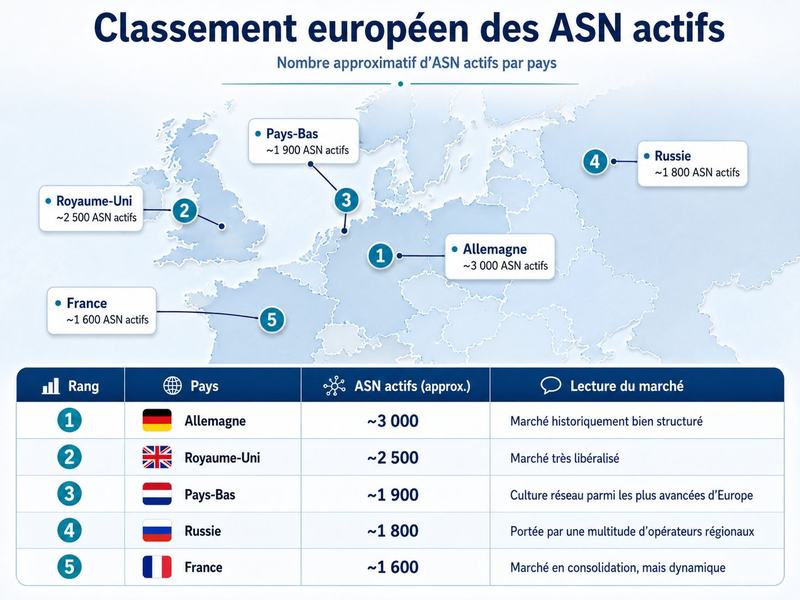
Because the more ASNs a country has, the more decentralized and resilient its Internet becomes: if one network goes down, the others keep running.
That’s why the European ASN rankings are so telling:
Which brings us back to that 99.97% of French companies that don’t have an ASN. And this is where the most persistent misconception lies: an ASN is not reserved for telecoms operators, hosting providers, CDNs, or major universities.
Any company that wants to take control of its Internet can have one. Any organization that wants to manage its traffic flows, choose its routes, and reduce its dependence on a single provider can have one.
The process is accessible. In Europe, an ASN is obtained through the RIPE NCC. What follows with BGP configuration, choosing transit providers and setting up peering requires technical expertise.
But it’s a well-mapped path, and players like France-IX are here to support those who want to take it.
This news was first published on LinkedIn. To comment or share it, head to the original post. → See the post