ARCEP
IPV6
PEERING
State of the Internet 2026: France leads the world on IPv6, public peering at 1.5% of traffic

France is now world number one on IPv6, at 74.7%. Meanwhile, public peering still accounts for only 1.5% of traffic. I was at Arcep’s press conference last week, and here is what you need to know.
Arcep, the French telecoms regulator, has just published its 2026 report on the state of the Internet in France.
And what stands out fairly quickly when you look at the figures more closely is that 55.2% of the big four operators’ traffic goes through transit, 43.2% through private peering, and only 1.5% through public peering via IXPs.
In other words, more than half of French users’ Internet traffic at the big four operators takes paths whose route nobody seriously looks at.
The good news concerns public peering capacity, which has grown, driven in particular by a massive increase in ports of up to 400G at France-IX, stabilising exchanged traffic at around 2.6 Tbit/s.
A small novelty: Arcep’s teams have also done some great work on AI, presented as a “gateway” to the Internet.
A test run on 3 AIs, 48,000 queries and around 200,000 sources reveals a striking figure: 2% of domain names account for 49% of the citations of the models tested.
A concentration that raises questions about the diversity of information in the age of generative AI.
We spoke at the conference to point out that interconnection remains the great absentee from the debate on digital sovereignty. Yet it is one of the most crucial questions!
We look forward to working with Arcep’s teams to shed more light on our data transport issues, a subject so material and physical that it is all too easily forgotten in a digital world that can seem almost immaterial.
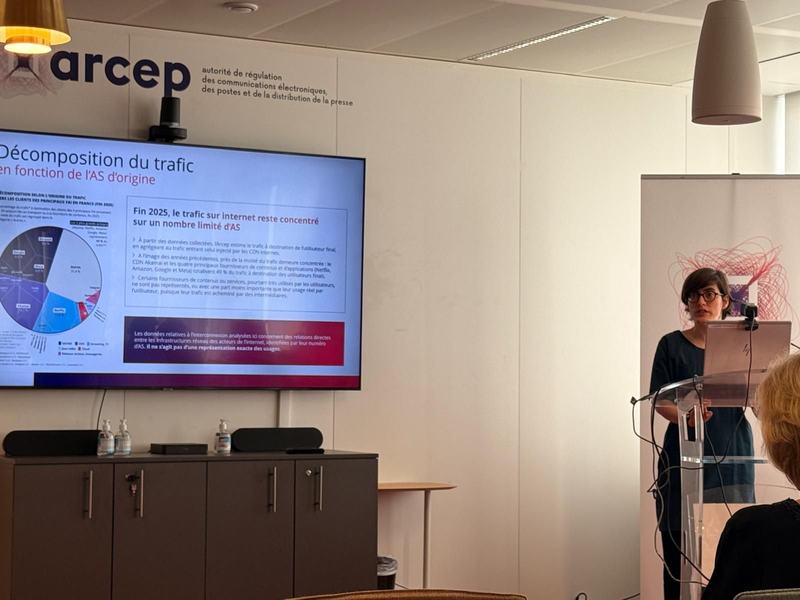
Illustration: Oriane Piquer-Louis at the Arcep conference (photo from the post)
This news was first published on LinkedIn. To comment or share it, head to the original post. → See the post