ARCEP
PUBLIC PEERING
TRANSIT
54% of French people’s Internet traffic goes through transit: what Arcep’s barometer shows

54% of French people’s Internet traffic goes through transit. In other words, over paths whose route nobody fully controls. Yet this is where an essential part of sovereignty is at stake.
This figure comes straight from the barometer published by Arcep, the French telecoms regulator. It is an interesting document, not read enough and too rarely discussed.
And that is not the only thing that stands out:
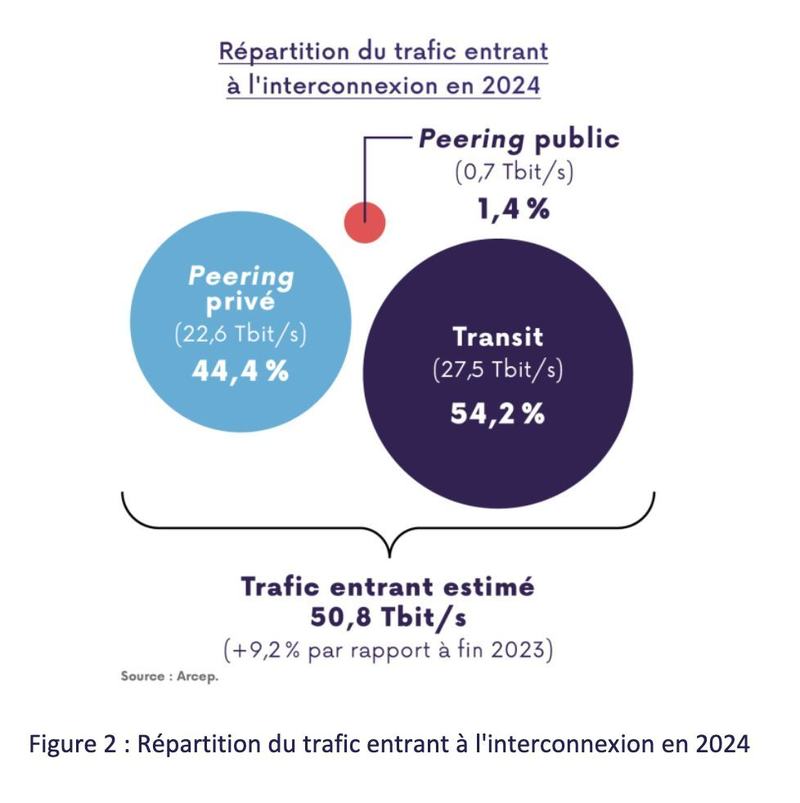
Incoming traffic to the four main French operators reaches 50.8 Tbit/s.
This traffic breaks down as follows: 54.2% via transit, 44.4% via private peering, and 1.4% via public peering through IXPs.
So transit is the default path, where your data passes through a series of intermediate networks before reaching its destination. But you have no control over the detail of these networks: it is a black box.
As for private peering, it is a direct interconnection between two organisations. Although the percentage is substantial, a closer look shows that this traffic is held by the GAFAM, mainly for entertainment. It can be relevant when you exchange traffic with one or two players, and that is it.
Public peering via IXPs (the solution that is both neutral and sovereign), for its part, represents a negligible percentage.
Storing data sovereignly while using transit is hard to justify from a digital sovereignty perspective. Notably because of the shadow of the Cloud Acts.
What good is a fortress if the drawbridge is down?
Corporate data, financial flows, institutional communications… This is precisely the traffic that benefits most from public peering.
The good news: we can change this.
Local peering is the answer to this blind spot. Keeping traffic in France, between French players, on known and controlled routes reduces dependence on international transit.
Increasing the share of traffic that goes through neutral and sovereign infrastructure. That is what the 600+ networks connected to France-IX are already doing.
Arcep’s next interconnection barometer comes out in a few days. This year, make the most of it! :)
Illustration: breakdown of incoming traffic at interconnection in 2024 (source: Arcep, chart from the post)
This news was first published on LinkedIn. To comment or share it, head to the original post. → See the post